
Speed of Transverse Wave | Speed of Transverse Wave on a Straight Wire
Speed of Transverse Wave | Speed of Transverse Wave on a Straight Wire :- In this article, we focus on determining the speed of a transverse pulse traveling on a taut string. Consider a pulse moving on a taut string to the right with a uniform speed v measured relative to a stationary frame of reference.
To obtain the expression for speed v it is convenient to describe the motion of pulse with respect to a reference frame that moves along with the pulse with the same speed as the pulse, so that the pulse appears to be at rest within the frame(as Newton’s laws are valid in either a stationary frame or a frame moving with constant velocity, so it is not violating the laws of motion).

Now from the moving frame of reference although the pulse appears to be at rest but the small segment of length Δl appears to be moving to the left with speed v. This small element of the string of length Δl forms an approximate arc of a circle of radius R and has a centripetal acceleration (ac) equal to v2/R, which is supplied by radial components of the tension force T in the string. The horizontal components of T cancel, and each vertical component T sinθ acts radially toward the center of the arc.
The total radial force on the element 2T sinθ acts as centripetal force, i.e,

Here we have assumed the approximation sinθ ≅ θ for small θ.
If μ is the mass per unit length of the string, the mass of the segment of length Δl is
m = μΔl = μ(2θR) = 2μRθ …..(2)
From Newton’s second law,


If D is the diameter of the string, L is its length and ρ is its density, then
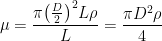


Also
μ = mass per unit length of the string

Here A is the cross sectional area of the string and V is the volume of the string. Hence the above expression can also be written as

Note:-
- We have derived the equations (3), (4) and (5) assuming that the pulse height is small relative to the length of the string. Using this assumption, we were able to use the approximation sinθ ≅ θ.
- This model assumes that the tension T is not affected by the presence of the pulse, hence T is the same at all points on the string.
- This derivation does not assume any particular shape for the pulse. Therefore, we conclude that a pulse of any shape travels along the string with speed given by equations (3), (4) and (5).
Example 1.
A uniform rope of length 12 m and mass 6 kg hangs vertically from a rigid support. A block of mass 2 kg is attached to the free end of the rope. A transverse pulse of wavelength 0.06 m is produced at the lower end of the rope. What is the wavelength of the pulse when it reaches the top of the rope.
(a) 0.06 m
(b) 0.12 m
(c) 0.09 m
(d) none of these
[IIT 1984]
Solution :


As frequency does not change,


Example 2.
A harmonic wave with a wavelength of 20 cm, an amplitude of 3 cm and a velocity of 2 ms-1 travels on a string to the left along the x-axis. The mass per unit length of the string is 0.25 gm-1. find :
(a) Frequency and period of the wave motion.
(b) Tension in the string.
(c) Position function for the wave.
Solution :
(a) The frequency,

The period,

(b) We know that

(c) In order to write the wave equation, we need to find out ω and k,

and

Thus the wave function is given by,

![\displaystyle \Rightarrow y=0.03sin\left[ \left( 20\pi \right)t+\left( 10\pi \right)x \right]](https://s0.wp.com/latex.php?latex=%5Cdisplaystyle+%5CRightarrow+y%3D0.03sin%5Cleft%5B+%5Cleft%28+20%5Cpi+%5Cright%29t%2B%5Cleft%28+10%5Cpi+%5Cright%29x+%5Cright%5D&bg=ffffff&fg=000&s=0&c=20201002 "Speed of Transverse Wave | Speed of Transverse Wave on a Straight Wire 23")
Example 3.
In the figure the string has a mass 4.5 g. How much time will it take for a transverse disturbance produced at the floor to reach the pulley? (Take g = 10 ms–2)

(A) 0.04 sec
(B) 0.2 sec
(C) 0.4 sec
(D) 0.02 sec
Solution :
Mass per unit length,


Wave speed,

Time taken to reach the pulley,

Correct option is (D).
Example 4.
A transverse wave described by y = 0.02 sin (x + 30t) propagates on a stretched string of linear mass density 12 gm–1. The tension in the string is
(A) 2.16 N
(B) 1.08 N
(C) 0.108 N
(D) 0.0108 N
Solution :
Wave function for a harmonic wave,
Comparing it with the given equation, y = 0.02 sin (x + 30t) we get


Wave velocity,

Hence tension in the string,

Correct option is (C).
Example 5.
A uniform rope of mass 0.1 kg and length 2.45 m hangs from a ceiling. Find :
(a) Speed of the transverse wave in the rope at a point 0.5 m from the lower end.
(b) Time taken by the transverse wave to travel through the full length of the rope. (Take g = 9.8 ms–2)
Solution :
(a) Tension in the rope at a point x meter above the lower end,

Speed of the transverse wave in the rope at a point x m from the lower end,

Here x = 0.5 m, hence


(b) The tension and hence the velocity of the wave is different at different points of the string. So, if at a point x above the lower end, the wave travels a distance dx in time dt, then


![\displaystyle \Rightarrow t=\int{dt}=\frac{1}{\sqrt{g}}\int\limits_{0}^{2.45}{{{x}^{-{1}/{2}\;}}dx}=\frac{1}{\sqrt{g}}\left[ \frac{{{x}^{{1}/{2}\;}}}{{1}/{2}\;} \right]_{0}^{2.45}](https://s0.wp.com/latex.php?latex=%5Cdisplaystyle+%5CRightarrow+t%3D%5Cint%7Bdt%7D%3D%5Cfrac%7B1%7D%7B%5Csqrt%7Bg%7D%7D%5Cint%5Climits_%7B0%7D%5E%7B2.45%7D%7B%7B%7Bx%7D%5E%7B-%7B1%7D%2F%7B2%7D%5C%3B%7D%7Ddx%7D%3D%5Cfrac%7B1%7D%7B%5Csqrt%7Bg%7D%7D%5Cleft%5B+%5Cfrac%7B%7B%7Bx%7D%5E%7B%7B1%7D%2F%7B2%7D%5C%3B%7D%7D%7D%7B%7B1%7D%2F%7B2%7D%5C%3B%7D+%5Cright%5D_%7B0%7D%5E%7B2.45%7D&bg=ffffff&fg=000&s=0&c=20201002 "Speed of Transverse Wave | Speed of Transverse Wave on a Straight Wire 41")
![\displaystyle \Rightarrow t=\frac{2}{\sqrt{g}}\left[ \sqrt{2.45}-0 \right]=2\times \sqrt{\frac{2.45}{9.8}}](https://s0.wp.com/latex.php?latex=%5Cdisplaystyle+%5CRightarrow+t%3D%5Cfrac%7B2%7D%7B%5Csqrt%7Bg%7D%7D%5Cleft%5B+%5Csqrt%7B2.45%7D-0+%5Cright%5D%3D2%5Ctimes+%5Csqrt%7B%5Cfrac%7B2.45%7D%7B9.8%7D%7D&bg=ffffff&fg=000&s=0&c=20201002 "Speed of Transverse Wave | Speed of Transverse Wave on a Straight Wire 42")

Example 6.
One end of 12.0 m long rubber tube with a total mass of 0.9 kg is fastened to a fixed support. A cord attached to the other end passes over a pulley and supports an object with a mass of 5.0 kg. The tube is struck a transverse blow at one end. Find the time required for the pulse to reach the other end. (g = 9.8 m/s²)
Solution :
The orientation of the rubber tube is not explicitly mentioned in the question. Therefore, we will first examine the two possible configurations :
- The tube is horizontal
- The tube is vertical
We will analyze both cases and compare the results.
🔶 Case 1: Tube Assumed Horizontal
If the rubber tube Ab is horizontal, the 5 kg mass hanging over the pulley provides uniform tension throughout the tube.

Mass per unit length of rubber tube,

Wave speed :

Time taken :

🔶 Case 2: Tube Assumed Vertical

If the tube is vertical, tension is not strictly uniform because each point must support the weight of the portion below it.
At a height y from the bottom :

Wave speed becomes position dependent :

Time is found using :
![\displaystyle t=\int_{0}^{L}{\frac{dy}{\upsilon (y)}}=\int\limits_{0}^{L}{\left[ \frac{dy}{\sqrt{\frac{g}{\mu }}\sqrt{(m+\mu y)}} \right]}=\sqrt{\frac{\mu }{g}}\int\limits_{0}^{L}{{{(m+\mu y)}^{{}^{-1}\!\!\diagup\!\!{}_{2}\;}}}dy](https://s0.wp.com/latex.php?latex=%5Cdisplaystyle+t%3D%5Cint_%7B0%7D%5E%7BL%7D%7B%5Cfrac%7Bdy%7D%7B%5Cupsilon+%28y%29%7D%7D%3D%5Cint%5Climits_%7B0%7D%5E%7BL%7D%7B%5Cleft%5B+%5Cfrac%7Bdy%7D%7B%5Csqrt%7B%5Cfrac%7Bg%7D%7B%5Cmu+%7D%7D%5Csqrt%7B%28m%2B%5Cmu+y%29%7D%7D+%5Cright%5D%7D%3D%5Csqrt%7B%5Cfrac%7B%5Cmu+%7D%7Bg%7D%7D%5Cint%5Climits_%7B0%7D%5E%7BL%7D%7B%7B%7B%28m%2B%5Cmu+y%29%7D%5E%7B%7B%7D%5E%7B-1%7D%5C%21%5C%21%5Cdiagup%5C%21%5C%21%7B%7D_%7B2%7D%5C%3B%7D%7D%7Ddy&bg=ffffff&fg=000&s=0&c=20201002 "Speed of Transverse Wave | Speed of Transverse Wave on a Straight Wire 52")
![\displaystyle t=\sqrt{\frac{\mu }{g}}\left[ \frac{{{(m+\mu y)}^{{}^{+1}\!\!\diagup\!\!{}_{2}\;}}}{{}^{+1}\!\!\diagup\!\!{}_{2}\;}\times \frac{1}{\mu } \right]_{0}^{L}](https://s0.wp.com/latex.php?latex=%5Cdisplaystyle+t%3D%5Csqrt%7B%5Cfrac%7B%5Cmu+%7D%7Bg%7D%7D%5Cleft%5B+%5Cfrac%7B%7B%7B%28m%2B%5Cmu+y%29%7D%5E%7B%7B%7D%5E%7B%2B1%7D%5C%21%5C%21%5Cdiagup%5C%21%5C%21%7B%7D_%7B2%7D%5C%3B%7D%7D%7D%7B%7B%7D%5E%7B%2B1%7D%5C%21%5C%21%5Cdiagup%5C%21%5C%21%7B%7D_%7B2%7D%5C%3B%7D%5Ctimes+%5Cfrac%7B1%7D%7B%5Cmu+%7D+%5Cright%5D_%7B0%7D%5E%7BL%7D&bg=ffffff&fg=000&s=0&c=20201002 "Speed of Transverse Wave | Speed of Transverse Wave on a Straight Wire 53")
![\displaystyle t=\frac{2}{\sqrt{\mu g}}\left[ {{(m+\mu y)}^{{}^{+1}\!\!\diagup\!\!{}_{2}\;}} \right]_{0}^{L}](https://s0.wp.com/latex.php?latex=%5Cdisplaystyle+t%3D%5Cfrac%7B2%7D%7B%5Csqrt%7B%5Cmu+g%7D%7D%5Cleft%5B+%7B%7B%28m%2B%5Cmu+y%29%7D%5E%7B%7B%7D%5E%7B%2B1%7D%5C%21%5C%21%5Cdiagup%5C%21%5C%21%7B%7D_%7B2%7D%5C%3B%7D%7D+%5Cright%5D_%7B0%7D%5E%7BL%7D&bg=ffffff&fg=000&s=0&c=20201002 "Speed of Transverse Wave | Speed of Transverse Wave on a Straight Wire 54")
![\displaystyle t=\frac{2}{\sqrt{0.075\times 9.8}}\left[ \sqrt{(5+0.075\times 12)}-\sqrt{5} \right]](https://s0.wp.com/latex.php?latex=%5Cdisplaystyle+t%3D%5Cfrac%7B2%7D%7B%5Csqrt%7B0.075%5Ctimes+9.8%7D%7D%5Cleft%5B+%5Csqrt%7B%285%2B0.075%5Ctimes+12%29%7D-%5Csqrt%7B5%7D+%5Cright%5D&bg=ffffff&fg=000&s=0&c=20201002 "Speed of Transverse Wave | Speed of Transverse Wave on a Straight Wire 55")
![\displaystyle t=\frac{2}{0.86}\times \left[ 2.43-2.24 \right]=\frac{0.38}{0.86}](https://s0.wp.com/latex.php?latex=%5Cdisplaystyle+t%3D%5Cfrac%7B2%7D%7B0.86%7D%5Ctimes+%5Cleft%5B+2.43-2.24+%5Cright%5D%3D%5Cfrac%7B0.38%7D%7B0.86%7D&bg=ffffff&fg=000&s=0&c=20201002 "Speed of Transverse Wave | Speed of Transverse Wave on a Straight Wire 56")

🔷 Final Observation
Both results are nearly equal :
0.47 sec and 0.44 sec
The difference (0.03) is very small because the mass of the tube (0.9 kg) is much smaller than the hanging mass (5 kg). Since the tension produced by the 5 kg mass is much larger than the weight of the rubber tube itself, the variation of tension along the tube is very small. Therefore, for simplicity and clarity of analysis, we can treat the system as effectively equivalent to a horizontal arrangement with uniform tension. This approximation greatly simplifies the calculation without significantly affecting the final result.
Example 7.
Two blocks each having a mass 3.2 kg are connected by a wire CD and the system is suspended from the ceiling by another wire AB as shown in figure. The
linear mass density of AB is 10 gm–1 and that of the CD is 8 gm–1. The speed of the transverse wave pulse produced in AB and CD is
 (A) 80 ms–1, 40 ms–1
(B) 40 ms–1, 80 ms–1
(C) 80 ms–1, 63 ms–1
(D) none of these
Solution :


Correct option is (C).