
Electric Polarization | What Is Electric Polarization
Electric Polarization | What Is Electric Polarization :- When a non-polar dielectric material is placed in an external electric field 

The electric field

Similarly, a polar dielectric also becomes polarized when placed in an electric field. In the absence of an external electric field, the molecules of the dielectric are randomly oriented, so their resultant dipole moment is zero. However, when an electric field is applied, each dipole (molecule) tends to align itself along the direction of the electric field. As a result, the polar dielectric acquires a net dipole moment.

The extent of polarization depends on the strength of the applied electric field
Therefore, when a dielectric material (polar or non-polar) is placed in an external electric field, the positive and negative charges present in its molecules or atoms are slightly displaced relative to each other in opposite directions. As a result, electric dipoles are formed (or aligned), and a net electric dipole moment per unit volume is produced in the material. This phenomenon is called electric polarization.
Effect of an External Electric Field on a Dielectric Slab
(Electric Polarization | What Is Electric Polarization)
Suppose a non-polar dielectric slab PQRS is placed between the two plates of a capacitor in a uniform electric field

Let us assume that in the presence of an external electric field
Polarization (
It is a vector quantity that indicates the extent to which a molecule or an atom can be polarized in the direction of the electric field in the presence of an external electric field. The polarization vector
⇒

Unit of Polarization (m-3)C-m = C-m-2
Substances whose molecules or atoms become polarized in the direction of an external electric field are called linear isotropic dielectrics. The induced dipole moments of different molecules combine to give the dielectric a net dipole moment in the presence of the external field.
For linear isotropic dielectrics, the polarization vector is proportional to the resulting (reduced) electric field. Hence, the polarization vector can also be expressed as follows :-

Where χe is a dimensionless constant called the electric susceptibility. The value of χe varies for different dielectric materials. For vacuum, χe = 0.
After polarization, the total charge within the dielectric (enclosed by the dashed line) is zero, because the positive charge of one dipole is positioned near the negative charge of another dipole, canceling each other out. However, a layer of charge is induced on the surface of the dielectric.
This charge is called the induced charge (Qi) or polarization charge, and due to the induced charge, the surface charge density is called the induced surface charge density (σi).
Again

The induced charge Qi generates a new electric field 
∴ Effective electric field in a polarized dielectric

Also
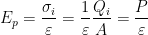
Dielectric Constant
(Electric Polarization | What Is Electric Polarization)
The ratio of the applied electric field

Relation Between Electric Susceptibility (χe) and Dielectric Constant (K)
(Electric Polarization | What Is Electric Polarization)
From equations (3) and (4),

Substituting the value of P from equation (1),


Hence, from equation (5),
