
Fourier Law of Heat Conduction
Fourier Law of Heat Conduction :- The Fourier’s Law of Heat Conduction is a fundamental principle in thermodynamics that describes the rate of heat transfer through a material by conduction. It was formulated by the French mathematician and physicist Jean-Baptiste Joseph Fourier. This law provides a mathematical relationship between the heat flux (rate of heat transfer per unit area) and the temperature gradient (rate of change of temperature) within a solid material.
Mathematical Expression of Fourier Law of Heat Conduction
It says that the heat flux across a substance is directly proportional to the temperature gradient, at 90 degrees to that gradient, in which flow of heat occurs. The law can be expressed mathematically(in one dimension) as follows :-
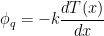
where:
- Φq represents the heat flux or thermal flux or heat flux density or heat-flow density or heat flow rate intensity (amount of heat transferred per unit time through a unit area) in watts per square meter (W/m2).
- k is the coefficient of thermal conductivity of the material in watts per meter per Kelvin [W/(m·K)] &
is the temperature gradient.
Note :-
- The negative sign shows that heat flux moves from higher temperature regions to lower temperature regions.
- Thermal conductivity (k) of a substance is nothing but the proportionality constant acquired in the expression. A body in which energy transfer occurs rapidly by the process of conduction is considered an excellent thermal conductor. Also, it has a significant value of k.
Fourier Law of Heat Conduction in 3 dimension
The three dimensional form of Fourier’s Law of Heat Conduction can be expressed as :-

where is the Del operator.

Rate of flow of heat through a rod
(Fourier Law of Heat Conduction)
Consider a rod of length l and area of cross-section A whose faces are maintained at temperature θ1 and θ2 respectively. The curved surface of rod is kept insulated from surrounding to avoid leakage of heat.

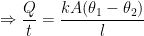
In steady state if Q amount of heat flows through the rod in time t, then using Fourier Law of Heat Conduction,

Hence, Rate of flow of heat(dQ/dt) i.e. heat current
 |
Fourier Law of Heat Conduction in differential form

Fourier Law of Heat Conduction for a rod of variable cross-section

where A(x) is the cross-sectional area of the rod at position x.
More about coefficient of thermal conductivity (k)
- Coefficient of thermal conductivity of a material is defined as the quantity of heat conducted per second through a unit area of a slab of unit length when the temperature difference between its ends is 1K (or 1 °C).
- It is the measure of the ability of a substance to conduct heat through it.
- The magnitude of K depends only on the nature of the material.
- Substances in which heat flows quickly and easily are known as good conductor of heat. They possesses large thermal conductivity due to large number of free electrons e.g. Silver, brass etc. For perfect conductors, k = ∞.
- S.I. unit – W/m– K or J/m–sec–K
- C.G.S. unit – cal./cm–sec oC
- Dimension : [MLT-3θ-1]
- Substances which do not permit easy flow of heat are called bad conductors. They possess low thermal conductivity due to very few free electrons e.g. Glass, wood etc. For perfect insulators, k = 0.
- The thermal conductivity of pure metals decreases with rise in temperature but for alloys thermal conductivity increases with increase of temperature.
- Human body is a bad conductor of heat but it is a good conductor of electricity.
- For some special cases, materials and states of matter, coefficient of thermal conductivity(k) :-
- kAg > kCu > kAl
- kSolid > kLiquid > kGas
- kMetals > kNon-Metals
Example 1.
For a conducting rod of length l temperature of two ends are T1 and T2 respectively. Its thermal conductivity depends upon temperature as following k = C/T, where C is a constant. The heat flow density through the rod will be :
(1).
![\displaystyle \frac{C}{l}\left[ log\left( \frac{{{T}_{2}}}{{{T}_{1}}} \right) \right]](https://s0.wp.com/latex.php?latex=%5Cdisplaystyle+%5Cfrac%7BC%7D%7Bl%7D%5Cleft%5B+log%5Cleft%28+%5Cfrac%7B%7B%7BT%7D_%7B2%7D%7D%7D%7B%7B%7BT%7D_%7B1%7D%7D%7D+%5Cright%29+%5Cright%5D&bg=ffffff&fg=000&s=0&c=20201002 "Fourier Law of Heat Conduction | Fourier's Law of Heat Conduction 11")
(2).
![\displaystyle \frac{C}{l}\left[ log\left( \frac{{{T}_{1}}}{{{T}_{2}}} \right) \right]](https://s0.wp.com/latex.php?latex=%5Cdisplaystyle+%5Cfrac%7BC%7D%7Bl%7D%5Cleft%5B+log%5Cleft%28+%5Cfrac%7B%7B%7BT%7D_%7B1%7D%7D%7D%7B%7B%7BT%7D_%7B2%7D%7D%7D+%5Cright%29+%5Cright%5D&bg=ffffff&fg=000&s=0&c=20201002 "Fourier Law of Heat Conduction | Fourier's Law of Heat Conduction 12")
(3).
![\displaystyle \frac{C}{l}\left[ log\left( {{T}_{1}}{{T}_{2}} \right) \right]](https://s0.wp.com/latex.php?latex=%5Cdisplaystyle+%5Cfrac%7BC%7D%7Bl%7D%5Cleft%5B+log%5Cleft%28+%7B%7BT%7D_%7B1%7D%7D%7B%7BT%7D_%7B2%7D%7D+%5Cright%29+%5Cright%5D&bg=ffffff&fg=000&s=0&c=20201002 "Fourier Law of Heat Conduction | Fourier's Law of Heat Conduction 13")
(4).
![\displaystyle Cl\left[ log\left( {{T}_{1}}{{T}_{2}} \right) \right]](https://s0.wp.com/latex.php?latex=%5Cdisplaystyle+Cl%5Cleft%5B+log%5Cleft%28+%7B%7BT%7D_%7B1%7D%7D%7B%7BT%7D_%7B2%7D%7D+%5Cright%29+%5Cright%5D&bg=ffffff&fg=000&s=0&c=20201002 "Fourier Law of Heat Conduction | Fourier's Law of Heat Conduction 14")
Solution :
Using Fourier Law of heat conduction, the the heat flow density/heat flux,

Given,
k = C/T
Hence,


Integrating both sides,


![\displaystyle \Rightarrow {{\phi }_{q}}\left[ x \right]_{0}^{l}=-C\left[ lo{{g}_{e}}T \right]_{{{T}_{1}}}^{{{T}_{2}}}](https://s0.wp.com/latex.php?latex=%5Cdisplaystyle+%5CRightarrow+%7B%7B%5Cphi+%7D_%7Bq%7D%7D%5Cleft%5B+x+%5Cright%5D_%7B0%7D%5E%7Bl%7D%3D-C%5Cleft%5B+lo%7B%7Bg%7D_%7Be%7D%7DT+%5Cright%5D_%7B%7B%7BT%7D_%7B1%7D%7D%7D%5E%7B%7B%7BT%7D_%7B2%7D%7D%7D&bg=ffffff&fg=000&s=0&c=20201002 "Fourier Law of Heat Conduction | Fourier's Law of Heat Conduction 20")
![\displaystyle \Rightarrow {{\phi }_{q}}\left[ l-0 \right]=-C\left[ lo{{g}_{e}}\left( \frac{{{T}_{2}}}{{{T}_{1}}} \right) \right]](https://s0.wp.com/latex.php?latex=%5Cdisplaystyle+%5CRightarrow+%7B%7B%5Cphi+%7D_%7Bq%7D%7D%5Cleft%5B+l-0+%5Cright%5D%3D-C%5Cleft%5B+lo%7B%7Bg%7D_%7Be%7D%7D%5Cleft%28+%5Cfrac%7B%7B%7BT%7D_%7B2%7D%7D%7D%7B%7B%7BT%7D_%7B1%7D%7D%7D+%5Cright%29+%5Cright%5D&bg=ffffff&fg=000&s=0&c=20201002 "Fourier Law of Heat Conduction | Fourier's Law of Heat Conduction 21")
![\displaystyle \Rightarrow {{\phi }_{q}}=\frac{C}{l}\left[ lo{{g}_{e}}\left( \frac{{{T}_{1}}}{{{T}_{2}}} \right) \right]](https://s0.wp.com/latex.php?latex=%5Cdisplaystyle+%5CRightarrow+%7B%7B%5Cphi+%7D_%7Bq%7D%7D%3D%5Cfrac%7BC%7D%7Bl%7D%5Cleft%5B+lo%7B%7Bg%7D_%7Be%7D%7D%5Cleft%28+%5Cfrac%7B%7B%7BT%7D_%7B1%7D%7D%7D%7B%7B%7BT%7D_%7B2%7D%7D%7D+%5Cright%29+%5Cright%5D&bg=ffffff&fg=000&s=0&c=20201002 "Fourier Law of Heat Conduction | Fourier's Law of Heat Conduction 22")
Hence correct option is (2).
Example 2.
A rod of length l and cross-section area A has a variable thermal conductivity given by K = αT, where α is a positive constant and T is temperature in kelvin. Two ends of the rod are maintained at temperature T1 and T2 (T1 > T2) . Heat current flowing through the rod will be :
(1).

(2).

(3).

(4).

Solution :
The heat current is given by,

Given,
K = αT
Hence,


![\displaystyle \Rightarrow \left( \frac{dQ}{dt} \right)\left[ x \right]_{0}^{l}=-\alpha A\left[ \frac{{{T}^{2}}}{2} \right]_{{{T}_{1}}}^{{{T}_{2}}}](https://s0.wp.com/latex.php?latex=%5Cdisplaystyle+%5CRightarrow+%5Cleft%28+%5Cfrac%7BdQ%7D%7Bdt%7D+%5Cright%29%5Cleft%5B+x+%5Cright%5D_%7B0%7D%5E%7Bl%7D%3D-%5Calpha+A%5Cleft%5B+%5Cfrac%7B%7B%7BT%7D%5E%7B2%7D%7D%7D%7B2%7D+%5Cright%5D_%7B%7B%7BT%7D_%7B1%7D%7D%7D%5E%7B%7B%7BT%7D_%7B2%7D%7D%7D&bg=ffffff&fg=000&s=0&c=20201002 "Fourier Law of Heat Conduction | Fourier's Law of Heat Conduction 30")
![\displaystyle \Rightarrow \left( \frac{dQ}{dt} \right)\left[ l-0 \right]=-\alpha A\left[ \frac{T_{2}^{2}}{2}-\frac{T_{1}^{2}}{2} \right]](https://s0.wp.com/latex.php?latex=%5Cdisplaystyle+%5CRightarrow+%5Cleft%28+%5Cfrac%7BdQ%7D%7Bdt%7D+%5Cright%29%5Cleft%5B+l-0+%5Cright%5D%3D-%5Calpha+A%5Cleft%5B+%5Cfrac%7BT_%7B2%7D%5E%7B2%7D%7D%7B2%7D-%5Cfrac%7BT_%7B1%7D%5E%7B2%7D%7D%7B2%7D+%5Cright%5D&bg=ffffff&fg=000&s=0&c=20201002 "Fourier Law of Heat Conduction | Fourier's Law of Heat Conduction 31")
![\displaystyle \Rightarrow \frac{dQ}{dt}=-\frac{\alpha A}{2l}\left[ T_{2}^{2}-T_{1}^{2} \right]](https://s0.wp.com/latex.php?latex=%5Cdisplaystyle+%5CRightarrow+%5Cfrac%7BdQ%7D%7Bdt%7D%3D-%5Cfrac%7B%5Calpha+A%7D%7B2l%7D%5Cleft%5B+T_%7B2%7D%5E%7B2%7D-T_%7B1%7D%5E%7B2%7D+%5Cright%5D&bg=ffffff&fg=000&s=0&c=20201002 "Fourier Law of Heat Conduction | Fourier's Law of Heat Conduction 32")

Hence correct option is (4).
Aliter
The heat current is given by,
Given,
K = αT
Hence,

Now,

And since the K varies linearly with T, we take the average temperature,

Using (a) and (b) we get,

