
Intensity of a wave | Power of a Wave
Intensity of a wave | Power of a Wave :- The power of a wave refers to the rate at which energy is transferred by the wave per unit of time. In other words, it is the amount of energy carried by the wave over a specific period.
Intensity of a wave is a measure of the energy flux or power per unit area carried by the wave as it propagates through a medium or space. It represents the concentration of energy within a given area perpendicular to the direction of wave propagation. It is measured in units of watts per square meter (W/m²).
Power in a string wave
(Intensity of a Wave | Power of a Wave)
In the article Energy of a Wave we derived an expression for energy associated with a traveling wave in a stretched string as given below :

here
μ = mass per unit length of the string (in kilograms per meter, kg/m)
ω = angular frequency of the wave (in radians per second)
amplitude of the wave (in meters, m)
λ = wavelength of the string wave (in meters, m)
Now in one time period (T), the string wave moves a distance equal to one wavelength(λ) as shown in figure below :

So from the definition, the power transported by the string wave,


Where:
- is the linear mass density of the string (in kilograms per meter, kg/m),
- is the angular frequency of the wave (in radians per second),
- is the amplitude of the wave (in meters, m),
- is the speed of the wave along the string (in meters per second, m/s).
Power and intensity of a wave travelling through a medium
(Intensity of a Wave | Power of a Wave)
When a particle performs simple harmonic motion, it possesses energy that continuously changes between kinetic and potential forms. In a progressive wave, this energy is carried through the medium along with the wave at speed v. The maximum particle velocity is given by

Energy per unit volume (energy density)

Where ρ is the density of the medium.
If S is the cross sectional area of the medium, the energy associated with a volume SΔx , will be

So power becomes
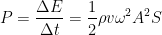
Hence Intensity

From equations (2) and (3),

Further in case of sound waves the displacement amplitude is related to the pressure amplitude through the relation :

[ ![\displaystyle [{{p}_{0}}=BAk={{v}^{2}}\rho A\frac{\omega }{v}=\rho vA\omega ]](https://s0.wp.com/latex.php?latex=%5Cdisplaystyle+%5B%7B%7Bp%7D_%7B0%7D%7D%3DBAk%3D%7B%7Bv%7D%5E%7B2%7D%7D%5Crho+A%5Cfrac%7B%5Comega+%7D%7Bv%7D%3D%5Crho+vA%5Comega+%5D&bg=ffffff&fg=000&s=0&c=20201002 "Intensity of a Wave | Power of a Wave 12")
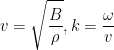
Hence


Again using
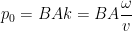

Putting this value in equation (3),


![\displaystyle [\because \rho {{v}^{2}}=B]](https://s0.wp.com/latex.php?latex=%5Cdisplaystyle+%5B%5Cbecause+%5Crho+%7B%7Bv%7D%5E%7B2%7D%7D%3DB%5D&bg=ffffff&fg=000&s=0&c=20201002 "Intensity of a Wave | Power of a Wave 20")

Hence intensity of sound waves is also given by equations (5) and (6).
Example 1.
A powerful electric siren of 300 W emits sound waves of frequency 1 kHz uniformly in all directions in air. A listener is standing at a distance of 100 m from the source. Assuming the speed of sound in air is 350 m/s and the density of air is 1.29 kg/m³, answer the following :
- Calculate the intensity of sound at the listener’s position.
- Determine the energy density of the sound wave at that point.
- Calculate the displacement amplitude of the air particles.
- Find the maximum particle velocity of the air molecules.
Solution :
(1). For spherical propagation,

(2). Energy density,

(3). Displacement amplitude,


Displacement amplitude ≈ 0.52 micrometer.
(4). Maximum particle velocity or the amplitude of the particle velocity is given by,


Example 2.
A point sound source emits spherical sound waves in a medium having bulk modulus B = 2.0 × 10⁵ Nm-2. At a distance of 20 m from the source, an observer records the wave equation as :
y = A sin (20πx – 8000πt)
where x and y are in meters and t is in seconds. The maximum pressure amplitude that the observer’s ear can safely tolerate is 40π Pa. Using this information, find :
(a). Density of the medium
(b). Displacement amplitude
(c). Intensity of the sound at the observer’s location
(d). Maximum power output of the sound source
Solution :
From the wave equation,

(a). Density of the Medium
Using,


(b). Displacement Amplitude A
Pressure amplitude relation,


(c). Intensity at Observer
Using


(d) Maximum Power of Source
For spherical waves :


